Rehabilitation and reconditioning in San Pedro, Marbella
Mon–Thu 9–14 & 16–19 · Fri 9–14
+34 628 508 860 | ES EN
We use our own and analytics cookies to understand how the website is used. You can accept them or continue with essential cookies only. More information
Necessary
Required for the website to work. Always on.
Always on
Analytics
Help us understand how many people visit the site and which pages they use (Google Analytics).
Marketing
Let us measure campaigns and show relevant ads on other websites.
Call WhatsApp Book now
Clínica San Pedro
{{ nav.label }}
WhatsApp Book now
Clínica San Pedro
{{ g.label }}

Rehabilitation and functional reconditioning in San Pedro de Alcántara and Marbella

Removing the pain isn't the end of treatment. It's halfway. Rehabilitation restores mobility and basic function to the injured area; functional reconditioning gives you back the strength, control and confidence to return to your sport, your job or daily life without fear of the injury coming back.
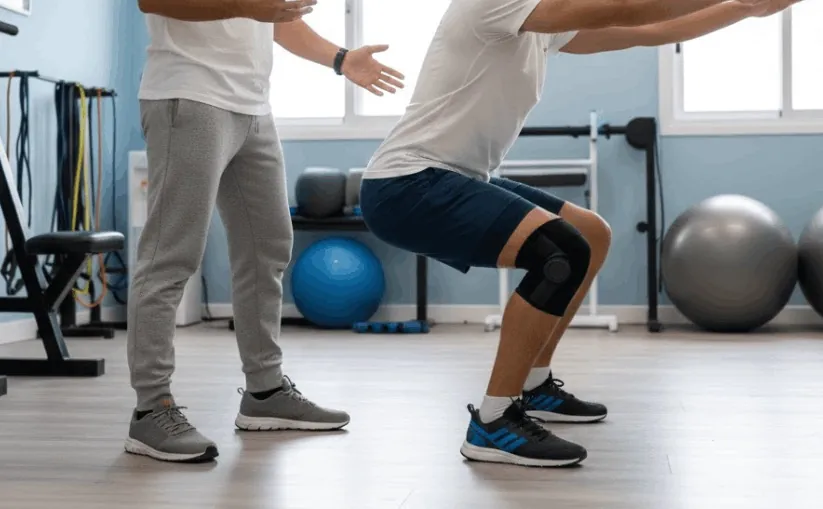
Physiotherapist supervising a squat by a patient wearing a knee brace during rehabilitation

Rehabilitation and reconditioning: two phases of the same process

People often confuse them, but they are not the same and are not done at the same time. One prepares the ground for the other: without rehabilitation, reconditioning isn't safe, and without reconditioning a relapse is only a matter of time.

Phase one
Rehabilitation

It starts right after the injury, surgery or diagnosis. The goal is to recover lost function: reduce inflammation, calm pain, restore range of movement to the joint and make sure the tissue heals properly.

What we do
Manual therapy, adapted therapeutic exercise, ultrasound monitoring of tissue progress, diathermy and electrotherapy when needed.
Phase two
Functional reconditioning

It starts when there is no more pain or limitation, and it is the phase that is almost always skipped. The goal here is not the joint, it's the person: regaining strength, movement control and the ability to tolerate load until the body can handle what you will ask of it.

What we do
Progressive strength, proprioception, motor control and reproduction of the specific movements of your sport or job.

Most relapses happen precisely in the gap between the two: the patient stops having pain, assumes they are cured and returns to activity with half the strength they had before. Rehabilitation closes that gap.

When you need a rehabilitation programme

{{ c.title }}
{{ c.desc }}

How we work, phase by phase

You don't move on to the next phase by calendar but by criteria. Before increasing load we check the previous one is consolidated, with measurements rather than feelings.
{{ f.n }}
{{ f.title }}
{{ f.desc }}

What makes our programme different

{{ k.title }}
{{ k.desc }}

Frequently asked questions

{{ q.q }}
{{ q.a }}

You may also be interested in

Invasive physiotherapy EPI and ultrasound-guided techniques View service → Sports physiotherapy Injury and return to sport View service → Paediatric physiotherapy Babies, children and teenagers View service → Pelvic floor Pregnancy, postpartum, incontinence View service →

Book your appointment

Book through our app or message us on WhatsApp and we will help you choose the treatment you need.

Calle Don Vito, Plaza de Istán 11, local 2
San Pedro de Alcántara (Marbella)
Monday to Thursday, 9:00 – 14:00 and 16:00 – 19:00 · Friday, 9:00 – 14:00
+34 628 508 860 · info@clinicasanpedro.es
Clínica San Pedro
Multidisciplinary health clinic in San Pedro de Alcántara and Marbella.
Calle Don Vito, Plaza de Istán 11, local 2
San Pedro de Alcántara (Marbella)
{{ col.title }}
{{ l.label }}
© 2026 Clínica San Pedro Legal notice Privacy Cookies Back to top ↑
Mon–Thu 9–14 & 16–19 · Fri 9–14
Call WhatsApp Book now
Clínica San Pedro

Rehabilitation and functional reconditioning in San Pedro de Alcántara and Marbella

Removing the pain isn't the end of treatment. It's halfway. Rehabilitation restores mobility and basic function to the injured area; functional reconditioning gives you back the strength, control and confidence to return to your sport, your job or daily life without fear of the injury coming back.

Physiotherapist supervising a squat by a patient wearing a knee brace during rehabilitation

Rehabilitation and reconditioning: two phases of the same process

People often confuse them, but they are not the same and are not done at the same time. One prepares the ground for the other: without rehabilitation, reconditioning isn't safe, and without reconditioning a relapse is only a matter of time.

Phase one
Rehabilitation

It starts right after the injury, surgery or diagnosis. The goal is to recover lost function: reduce inflammation, calm pain, restore range of movement to the joint and make sure the tissue heals properly.

What we do
Manual therapy, adapted therapeutic exercise, ultrasound monitoring of tissue progress, diathermy and electrotherapy when needed.
Phase two
Functional reconditioning

It starts when there is no more pain or limitation, and it is the phase that is almost always skipped. The goal here is not the joint, it's the person: regaining strength, movement control and the ability to tolerate load until the body can handle what you will ask of it.

What we do
Progressive strength, proprioception, motor control and reproduction of the specific movements of your sport or job.

Most relapses happen precisely in the gap between the two: the patient stops having pain, assumes they are cured and returns to activity with half the strength they had before. Rehabilitation closes that gap.

When you need a rehabilitation programme

After surgery
Cruciate ligament, meniscus, rotator cuff, hip or knee replacement, operated disc herniation. The tissue heals, but strength and control don't come back on their own: they need to be rebuilt progressively.
After a muscle or tendon injury
Muscle tears, tendinopathies, recurring sprains. If you return to activity when the pain goes but before regaining strength, a relapse is very likely.
When the injury keeps coming back in the same place
Low back pain that returns every few months, ankles that twist again and again, shoulders that always get overloaded the same way. A sign that the problem isn't solved, only calmed.
To return to sport safely
Being pain-free isn't enough. We measure strength, symmetry between sides and control of the sporting movement before discharging you to compete.
To return to physical work
Lifting, bending, holding postures for hours. We prepare your body for the real demands of your job, not for those of a generic gym.
After a long period of inactivity
Prolonged rest, illness or simply years without activity. We rebuild your base of strength and mobility before you try to get fit and injure yourself in the process.

How we work, phase by phase

You don't move on to the next phase by calendar but by criteria. Before increasing load we check the previous one is consolidated, with measurements rather than feelings.

01
Initial assessment
Medical history, examination and ultrasound if the injury requires it. We measure range of movement, strength and differences between the injured and healthy side, and talk about your real goal: running again, lifting at work, playing on Sunday.
02
Pain control and recovery of mobility
The rehabilitation phase itself. Manual therapy, adapted exercise and technology so the tissue heals well and the joint recovers its full range without pain.
03
Strength recovery
Specific, progressive strengthening of the affected area and everything that supports it. This is where you gain what prevents relapse: tissue that can tolerate load.
04
Motor control and proprioception
We work on the movement pattern: so the joint reacts well, the movement is efficient and the body distributes load as it should instead of always overloading the same spot.
05
Specific movements for your sport or job
We reproduce real demands in the gym: changes of direction, jumps, running, lifting, sustained postures. The transition between being recovered and being ready.
06
Discharge and prevention
You leave having met objective criteria and with a maintenance plan: which exercises to keep doing, how often and what signs to watch for. The goal is that you don't have to come back for the same thing.

What makes our programme different

Individualised
The programme is adjusted to your injury, age, previous level and goal. Two people with the same injury don't do the same thing.
Measured progression
Load increases when the criteria are met, not when the calendar says so. Neither before, which causes relapses, nor after, which drags out recovery for no reason.
Active, not passive
Therapeutic exercise is the main tool. Manual techniques and technology support it, but what rebuilds the tissue is the work you do.
Coordinated with orthopaedics
When surgery or a medical diagnosis is involved, physiotherapy and orthopaedics work on the same case in the same clinic, with no reports lost between centres.

Frequently asked questions

How long does reconditioning take?
It depends on the injury and your starting point. Rehabilitation after a sprain can take weeks; after an ACL reconstruction we are talking about several months. At the initial assessment we give you an estimated timeframe and the goals for each phase.
Is it the same as going to the gym?
No. The exercises may look similar, but here there is a diagnosis behind them, a controlled progression and constant review of how the tissue responds. A generic programme doesn't take your injury into account.
Do I need to be pain-free to start?
No. Rehabilitation starts when the injury is stable, which isn't the same as being free of discomfort. Starting too late also has a cost: you lose muscle mass and control.
How many sessions a week?
Usually two sessions a week at the clinic plus prescribed work at home. As you progress, clinic sessions become less frequent and independent work takes on more weight.
Do I need a medical report or referral?
It isn't essential. If you have imaging or a report from your orthopaedic specialist, bring them: they save time and sharpen the plan. If not, we assess you and refer you if needed.

You may also be interested in

Invasive physiotherapy EPI and ultrasound-guided techniques View service → Sports physiotherapy Injury and return to sport View service → Paediatric physiotherapy Babies, children and teenagers View service → Pelvic floor Pregnancy, postpartum, incontinence View service →

Book your appointment

Book through our app or message us on WhatsApp and we will help you choose the treatment you need.

Calle Don Vito, Plaza de Istán 11, local 2
San Pedro de Alcántara (Marbella)
Monday to Thursday, 9:00 – 14:00 and 16:00 – 19:00 · Friday, 9:00 – 14:00
+34 628 508 860 · info@clinicasanpedro.es
Clínica San Pedro
Multidisciplinary health clinic in San Pedro de Alcántara and Marbella.
Calle Don Vito, Plaza de Istán 11, local 2
San Pedro de Alcántara (Marbella)
© 2026 Clínica San Pedro Legal notice Privacy Cookies Back to top ↑